

Promote your book here for just $50 for one year. We’ll include your book cover, a description of your book, and a link to where your book can be purchased.
Click book cover or book title for information about the book you wish to learn more about.
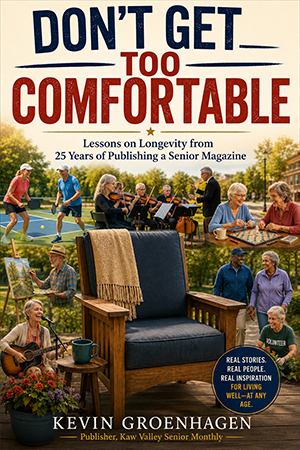
In 2001, Kevin Groenhagen launched Kaw Valley Senior Monthly with six advertisers and a cover story about a runner who hadn’t discovered the sport until age 58. Twenty-five years and more than 300 interviews later, he realized he hadn’t just been publishing a magazine. He’d been taking notes on how to age well. Don’t Get Too Comfortable draws on a quarter century of conversations with the people who seemed to do it best — the 75-year-old teaching 14 hours of fitness classes a week, the couple who earned black belts after 50, the man who led 135 safaris to Africa, and many more.
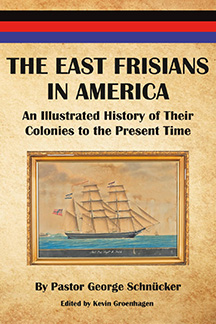
In 1917, Pastor Schnücker published Die Ostfriesen in Amerika: Eine illustrierte Geschichte ihrer Kolonien bis zur Gegenwart (The East Frisians In America: An Illustrated History of Their Colonies to the Present Time). An empathetic storyteller, Pastor Schnücker chronicled the lives of East Frisian settlers during their first six decades in the United States. It is hoped that this new English version will inform more recent generations of their ancestors’ hardships, struggles, perseverance, and triumphs.
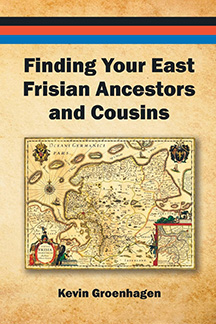
Realizing there are few books that specifically cover the unique intricacies of East Frisian genealogy, Groenhagen decided to share what he has learned about East Frisian genealogy during the past 30 years. In Finding Your East Frisian Ancestors and Cousins, Groenhagen discusses techniques and sources you can use to find your ancestors and cousins in both the United States and East Friesland. Groenhagen shares online and print resources he used to find his own ancestors and cousins, discusses the practice of patronymics, and includes a chapter on genetic genealogy, which has introduced science to the art of genealogy. Groenhagen also includes a chapter on how to write and publish a book about your ancestors and cousins after you have done your research.
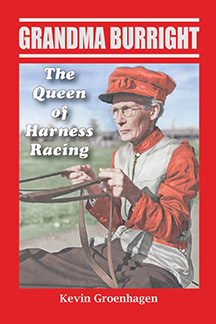
Neva “Grandma” Burright was born on a race track in 1883, and her 57-year career as a harness racing driver spanned the county fair circuit to the early years of pari-mutuel harness racing after World War II. During the 1940s and 1950s, major newspapers from Boston to Honolulu reported on Grandma Burright’s exploits as a harness racing driver. In 1943, she became the first woman to win a Grand Circuit race. In doing so, she defeated the legendary Sep Palin, “the aristocrat of drivers,” who had the financial backing of automobile heiress Frances Dodge Johnson. During that Grand Circuit race in Delaware, Ohio, Grandma Burright and Luckyette, her bay gelding, also shocked the harness racing world by setting a record for women drivers over a half-mile track with a time of 2:04 ¾. In addition to Grandma Burright’s victories on race tracks, general audience magazines such asCoronet, Esquire, Hit!, Life, andLook magazines featured her in articles. She also appeared before millions on national television in 1954 and stumped the panelists on What’s My Line? In Grandma Burright: The Queen of Harness Racing, Kevin Groenhagen explores Grandma Burright’s legacy as a wife, mother, grandmother, and, of course, as a harness racing driver. He examines how a diminutive woman of modest means overcame numerous tragedies (the death of a husband, two grandsons, and two sons, all within 12 years) to become known as “The Queen of Harness Racing.”
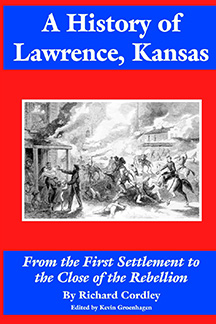
A History of Lawrence, Kansas: From the First Settlement to the Close of the Rebellion. Reprint of Richard Cordley’s 1895 book on the founding of Lawrence, Kansas, and Quantrill’s Raid of August 21, 1863. New edition includes an editor’s introduction, photos added from the Library of Congress, recent photos taken in Lawrence and Lecompton, recent articles on the Eldridge Hotel and the House Building, and a comprehensive index (the original lacked an index).
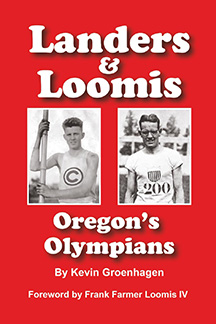
In 1916, Landers and Loomis made up Oregon (Ill.) High School’s track and field team and made newspaper headlines throughout the United States. They won 13 scholastic meets during their senior of high school. In addition, Landers set a high school record of 12’ 8” in the pole vault. This was during the bamboo pole era. After high school, they went their separate ways but were reunited for the Seventh Olympiad in Antwerp, Belgium, in 1920. The Sixth Olympiad, scheduled to take place in Berlin in 1916, was canceled due to World War I. In addition to being the first Olympics after World War I, the Seventh Olympiad featured a few other firsts. The Olympic flag was introduced at the Antwerp Games with its five interlaced rings representing the union of the five continents and the meeting of athletes worldwide. The Antwerp Games were also the first to feature the reading of the Olympic oath and the release of doves, a symbol of peace. Landers placed fifth in the hop, skip, and jump (triple jump) at the Seventh Olympiad and defeated a former world record holder in that event. Loomis won a gold medal in the 400-meter hurdles and set a world record of 54 seconds. Landers & Loomis: Oregon’s Olympians tells the story of how and where the athletes met and became friends, how they came to compete for Oregon High School, and their lives both on and off the track field.

DOWNLOAD FOR FREE. There’s a moment many retirees recognize — reviewing a bank statement, facing an unexpected repair bill, or simply doing the math on how many years still lie ahead. Smart Savings is written for that moment. This book skips the jargon-heavy advice written for people with investment portfolios the size of small endowments, and the condescending tips that treat readers like they’ve never balanced a checkbook. Instead, you’ll find practical, respectful guidance on the things that actually matter: making sense of Social Security, Medicare, and pensions; deciding whether to downsize; finding the discounts and benefit programs hiding in plain sight; navigating taxes, estate planning, and long-term care; and building real peace of mind into your financial life. This isn’t a book about deprivation. It’s a book about intention — making sure your money goes toward what genuinely matters to you, and not toward what doesn’t. Whether you’re stretching a tight budget or simply want to make smarter use of what you have, Smart Savings offers the kind of advice you’d get from a trusted friend who happens to know a great deal about money
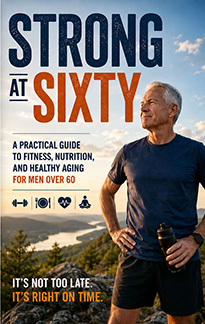
There’s a moment most men over 60 can identify. Maybe it came when you bent down to pick something up off the floor and had to think about how you were going to get back up. Maybe it was a doctor visit where the numbers weren’t what they used to be, and you walked out with a prescription instead of a plan. Whatever the moment was, it probably came with a thought: Is this just how it goes from here? The answer is no. The fitness industry has a problem with men over 60 — it either ignores you entirely or patronizes you with watered-down programs built around what it assumes you can no longer do. Strong at Sixty does neither. Here’s what the research actually shows: the human body responds to exercise at every age. Muscle can be built in your 60s, 70s, and beyond. Cardiovascular health can improve. Bone density can be maintained — even increased. The body you have today is still capable of meaningful, measurable improvement. This book takes seriously what does change after 60 — recovery, hormones, the narrower margin for ignoring sleep and nutrition — and builds a genuine, evidence-based roadmap around it. You don’t need to have been an athlete. You just need to be done accepting decline as the default